





 Back to discover
Making a case for nuts and seeds in dietary guidelines.
Dr Frankie Phillips and Dr Carrie Ruxton report from a recent roundtable event, hosted by Whitworths and the BDA, to discuss the potential place of nuts and seeds in dietary messaging.
Less than 0.1% of the UK population achieves all the Eatwell dietary guidelines. This has led to a nutrition gap for fibre and certain vitamins and minerals, necessitating novel approaches to improve public health nutrition.
A recent roundtable event, hosted by Whitworths and the BDA, brought together dietitians and nutritionists from across a range of disciplines to discuss the potential place of nuts and seeds – both nutrient-dense foods – in future dietary messaging.
Fibre, fruit and vegetables – the current nutrition gap
Escalating obesity rates and sugar consumption have dominated the health agenda for decades but less has been said about inadequate intakes of positive foods and nutrients – for example fruit, vegetables and fibre.
The latest National Diet and Nutrition Survey (NDNS) reveals that there is a significant nutrition gap as shown in Table 1.
Table 1: The nutrition gap
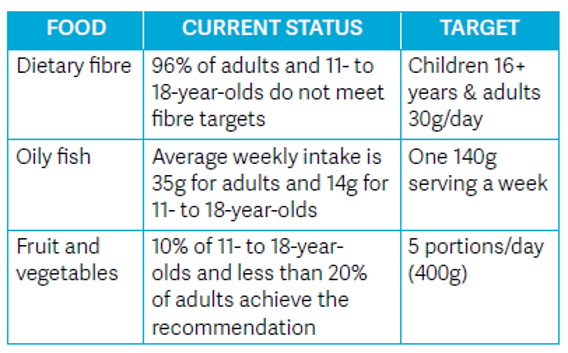
Cereals and cereal products are the main source of fibre, providing 43–50% of intakes, followed by vegetables and vegetable products, providing 25%. Despite their high fibre content, nuts and seeds only contribute 1% of fibre intakes, mainly because people eat them so infrequently.
While dietitians agree that awareness of certain dietary guidelines is high, especially 5-a-day, this does not translate into food choices. Yet small, sustainable dietary shifts could make a big difference according to The Food Foundation, which reported that reducing dietary risks could cut early mortality and years living with disability by around 10%.
Focus on 5-a-day messaging
The 5-a-day target has been around for more than two decades. According to a 2024 YouGov survey commissioned by Whitworths, 92% of the 2,071 UK adults polled were aware of the message, while 59% claimed to be eating 5-a-day. In contrast, the NDNS reports that just 17% met the target, with average consumption at 3.3–3.7 portions per day. Among 11- to 18-year-olds, fewer than one in ten achieves 5-a-day.
Nearly 80% of people say they want to increase their fruit and vegetable intake. However, barriers include the high cost of fresh fruit and vegetables and a perceived lack of preparation time.
Confusion about the specifics of 5-a-day was evident among those surveyed. Only 11% recognised they should aim for variety and, while 65% knew that dried fruit counts, just a third were aware that 30g is a portion.
The concept of 5-a-day was debated and it was clear current messaging is not driving consumption increase. Among millennials and Gen Z, it is estimated that 87% get their nutrition information from social media, but only 2% of the content is accurate.
The 30 plants per week message, emerging from the American Gut Study and promoted by media personalities, has caused a buzz. Dietitians recognised the positivity of encouraging plant diversity, but felt the message was confusing.
Health benefits of nuts and seeds
Nuts and seeds are nutrient-dense, varied and versatile plant foods. A small handful contributes meaningfully to fibre intake, omega-3 and omega-6 fatty acids, plant-based protein, vitamin E, folate, magnesium, zinc, selenium and potassium. They also contain a wide range of bioactive compounds, including polyphenols and phytosterols.
There is substantial evidence supporting the health benefits of eating nuts, including for cardiovascular health, weight management and mental health.
A place for nuts and seeds in dietary recommendations
Almost all European food-based dietary guidelines include recommendations for nuts and seeds. These range from a daily intake of 20–30g to eating nuts and seeds once or twice a week.
There was agreement that a portion size of nuts and seeds should be 25–30g, although if nuts and seeds are used as the predominant source of protein in a main meal, this could increase to around 60g.
Despite aligning with government health targets, the UK National Food Strategy and sustainability goals, nuts and seeds are currently excluded from the 5-a-day message.
Opinions were divided on where best to place nuts and seeds in the Eatwell Guide. Some suggested they belong in both the fruit and vegetable group and the protein group. Others felt a separate section would be more appropriate.
There was unanimous agreement that there is a need to draw attention to the valuable and versatile role of nuts and seeds in the diet.
Overcoming barriers to consumption
Nuts and seeds can be used in many ways, including on yoghurt, in salads, with noodle dishes, as snacks, in cereal bars, or incorporated into main meals.
Barriers include lack of awareness about their health benefits, perceived cost, choking and allergy concerns, confusion about portion sizes and concerns about weight gain.
The group agreed that many of these barriers could be overcome through positive communication and myth-busting.
The future: communicating a place for nuts and seeds in dietary guidelines
There is a role for nuts and seeds beyond their current positioning on the Eatwell Guide. Broadening the 5-a-day message to include more plants, such as nuts and seeds, deserves further consideration.
The consensus was that the 5-a-day message is familiar but imperfect and may serve as a foundation for future updates rather than a complete replacement.
Key takeaway messages
– Clarify a role for nuts and seeds and recognise their potential to shrink the nutrition gap.
– Improve the simplicity and clarity of nutrition messaging and address misinformation.
– Highlight the cost, taste, convenience and health benefits of nuts and seeds for everyone.
References:
- Office for Health Improvement and Disparities (2025). National Diet and Nutrition Survey 2019 to 2023. Available at: www.gov.uk/government/statistics/national-diet-and-nutrition-survey-2019-to-2023. Accessed May 2026.
- Food Foundation (2025). The Broken Plate. Available at: www.foodfoundation.org.uk/publication/broken-plate-2025. Accessed May 2026.
- McDonald D et al. (2018). American Gut: an Open Platform for Citizen Science Microbiome Research. mSystems. 15;3(3):e00031-18.
- Coates AM et al. (2018). Nuts and Cardiovascular Disease Prevention. Curr Atheroscler Rep. 9;20(10):48.
- Baer DJ et al. (2023). Nuts, Energy Balance and Body Weight. Nutrients. 25;15(5):1162.
- Bizzozero-Peroni B et al. (2023). Nut consumption is associated with a lower risk of depression in adults: A prospective analysis with data from the UK Biobank cohort. Clin Nutr. 42(9):1728-1736.